
Let's get something straight: your startup idea might be brilliant, your pitch deck might be gorgeous, and your team might be stellar: but if your digital product feels like navigating a labyrinth blindfolded, you're toast. In Dubai's hypercompetitive startup ecosystem, where 98% of users are glued to their smartphones and investors have seen every pitch under the sun, your UI/UX design isn't just a nice-to-have. It's your first impression, your silent salesperson, and quite possibly the difference between securing that Series A or watching users bounce to your competitor.
Welcome to the ultimate guide to UI/UX design for Dubai startups: where we'll break down why professional design is your secret weapon, what separates pretty interfaces from conversion machines, and how to build digital experiences that actually work in this market.
Why Dubai Startups Can't Afford to Skimp on UX
Dubai isn't your average startup market. It's multicultural, digitally mature, and moves at warp speed. Your potential users have interacted with apps from Silicon Valley, Europe, and Asia. They know what good looks like, and they have zero patience for anything less.
Here's the uncomfortable truth: a confusing interface doesn't get a second chance here. Users drop apps immediately, investors see through surface-level polish, and your competitors are already investing in proper ui ux design services. The cost of getting this wrong isn't just a few lost users: it's wasted development budgets, expensive redesigns, and momentum you'll never get back.
But here's the good news: when you get UX right from the start, everything else gets easier. Development moves faster because the structure is clear. Conversions improve because friction disappears. Investors lean in because your product demonstrates strategic thinking, not just pretty colors.

Simple Design vs. Strategic UI/UX: Know the Difference
Let's clear up a massive misconception: UI design and UX design are not the same thing, and slapping a nice interface on a poorly structured product is like putting racing stripes on a car with no engine.
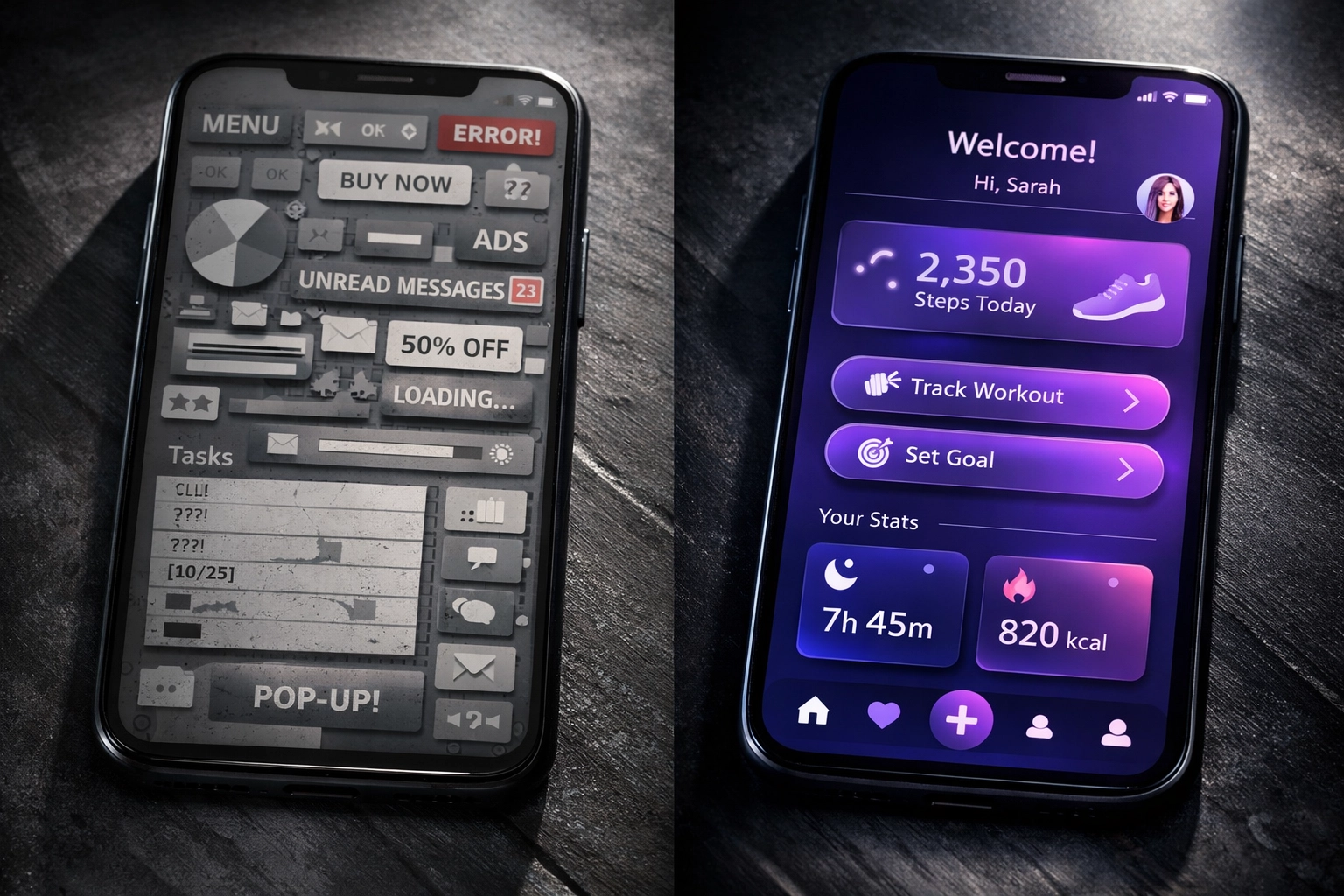
Simple design makes things look good. It focuses on colors, typography, and visual hierarchy. It's what most agencies default to because it's easier to deliver and looks impressive in portfolio screenshots.
Strategic UI/UX makes things work. It starts with understanding user behavior, mapping journeys, identifying pain points, and building logical flows before a single pixel gets pushed. It's the difference between a website that looks sleek and one that actually converts visitors into customers.
Think of it this way: UI is the icing; UX is the entire cake recipe. And in Dubai's market, users can taste the difference instantly.
When you prioritize UX first, you're building with intention. Every button placement, every form field, every screen transition serves a purpose. You're not decorating: you're solving problems. This is what separates startups that scale from those that stall.
The Real Cost of Getting UX Wrong
Many founders believe that investing in proper UX slows them down. They want to "move fast and break things," so they skip the research, skip the wireframing, and jump straight to building. Then they wonder why users churn, why conversions tank, and why their development team keeps rebuilding the same features.
Here's what actually happens when you skip UX:
Your developers build features without clear direction, leading to constant rewrites. Your support team drowns in tickets from confused users. Your investors see a product that looks unfinished and unthoughtful. Your users leave and never come back because: let's be honest: there are dozens of alternatives one tap away.
Contrast that with a UX-first approach: your team moves faster because everyone understands the structure, your users onboard smoothly because the journey makes sense, and your product feels premium even before you add the visual polish.
Building for Dubai's Mobile-First Reality
With nearly universal smartphone penetration in the UAE, mobile isn't an afterthought: it's the primary experience. Yet so many startups still design for desktop first and treat mobile as a scaled-down version. Big mistake.
Responsive web design in Dubai means starting with the smallest screen and building up. It means understanding that your users are multitasking, often on-the-go, and expecting instant results. They're booking services between meetings, making purchases while sitting in traffic, and researching products while waiting for their coffee.
Your interface needs to work flawlessly across devices, load instantly, and accommodate thumb-friendly navigation. This isn't just about making things fit on smaller screens: it's about rethinking the entire experience for how people actually use their phones.
When you partner with a web development agency dubai that understands this reality, they don't just shrink your desktop site. They reimagine the entire user journey for mobile-first behavior.
The Tadween Space Approach: Where Strategy Meets Design
At Tadween Space, we've seen every mistake startups make (because we've helped fix most of them). Our approach to custom web design starts with a question that most agencies skip: "What does your user actually need to accomplish?"
Notice we didn't ask about color preferences or font choices. Those come later. First, we need to understand your business goals, your users' pain points, and the journey that connects them.
"Design is not just what it looks like and feels like. Design is how it works." : Steve Jobs
Our process for custom website development follows a clear framework:
Discovery and Research: We dig into your business model, study your competitors, and map out your target audience's behavior. This isn't busywork: it's the foundation that prevents expensive mistakes later.
Wireframing and Structure: Before any visual design happens, we create clear blueprints of every screen, every interaction, and every user flow. Think of this as the architectural plans before construction begins.
Prototyping and Testing: We build clickable prototypes that let you experience the product before it's fully developed. This is where we validate assumptions, identify friction points, and refine the experience.
Visual Design and Branding: Only after the structure is solid do we layer in the visual identity. When UI design is built on top of strong UX, it feels intentional, cohesive, and premium.

Why Custom Beats Template Every Time
Template platforms promise quick launches and low costs. They're tempting, especially for bootstrapped startups. But here's what they don't tell you: templates are built for generic use cases, not your specific user journey.
Your startup isn't generic. Your users have specific needs, your business model has unique requirements, and your competitive advantage depends on differentiation. A template can't give you that.
Custom development means your interface is optimized for your exact use case. Forms are streamlined for your data requirements. Navigation is structured around your service hierarchy. The entire experience is tuned for conversion, not just visual appeal.
This is particularly crucial for SaaS platforms and mobile apps: the products most Dubai startups are building. These need to scale, evolve, and maintain consistency as you add features. A template becomes a cage; custom development becomes a foundation you can build on.
Scalability: Designing for Growth, Not Just Launch
Launch day is exciting, but it's just day one. The real question is: what happens when you add that new feature in month three? Or when you expand to a new market in year two? Or when user feedback reveals a behavior you didn't anticipate?
Startups that invest in scalable ui ux design services don't have to rebuild their product every time they grow. They have a design system: a set of reusable components, clear patterns, and documented standards that keep the experience consistent even as the product evolves.
This is what separates products that feel polished at scale from those that become Frankenstein monsters of mismatched features and inconsistent interactions.
At Tadween Space, we build with tomorrow in mind. Every design decision considers how it will accommodate new features, how it will adapt to different user segments, and how it will maintain coherence as your startup scales.
The Bottom Line for Dubai Founders
Your startup's success in Dubai depends on standing out in a crowded, sophisticated market. Professional UI/UX design isn't an expense: it's an investment in faster development, higher conversions, stronger investor confidence, and lower support costs.
The choice isn't between cheap and expensive design. It's between strategic design that drives business results and surface-level polish that looks good in screenshots but fails in practice.
If you're building something meant to last, start with the right foundation. Your users will notice the difference, your investors will appreciate the thoughtfulness, and your competitors will wonder how you made it look so easy.
Ready to build a digital product that actually works for Dubai's demanding market? Let's talk about turning your vision into an experience users love.
Leave a Reply