
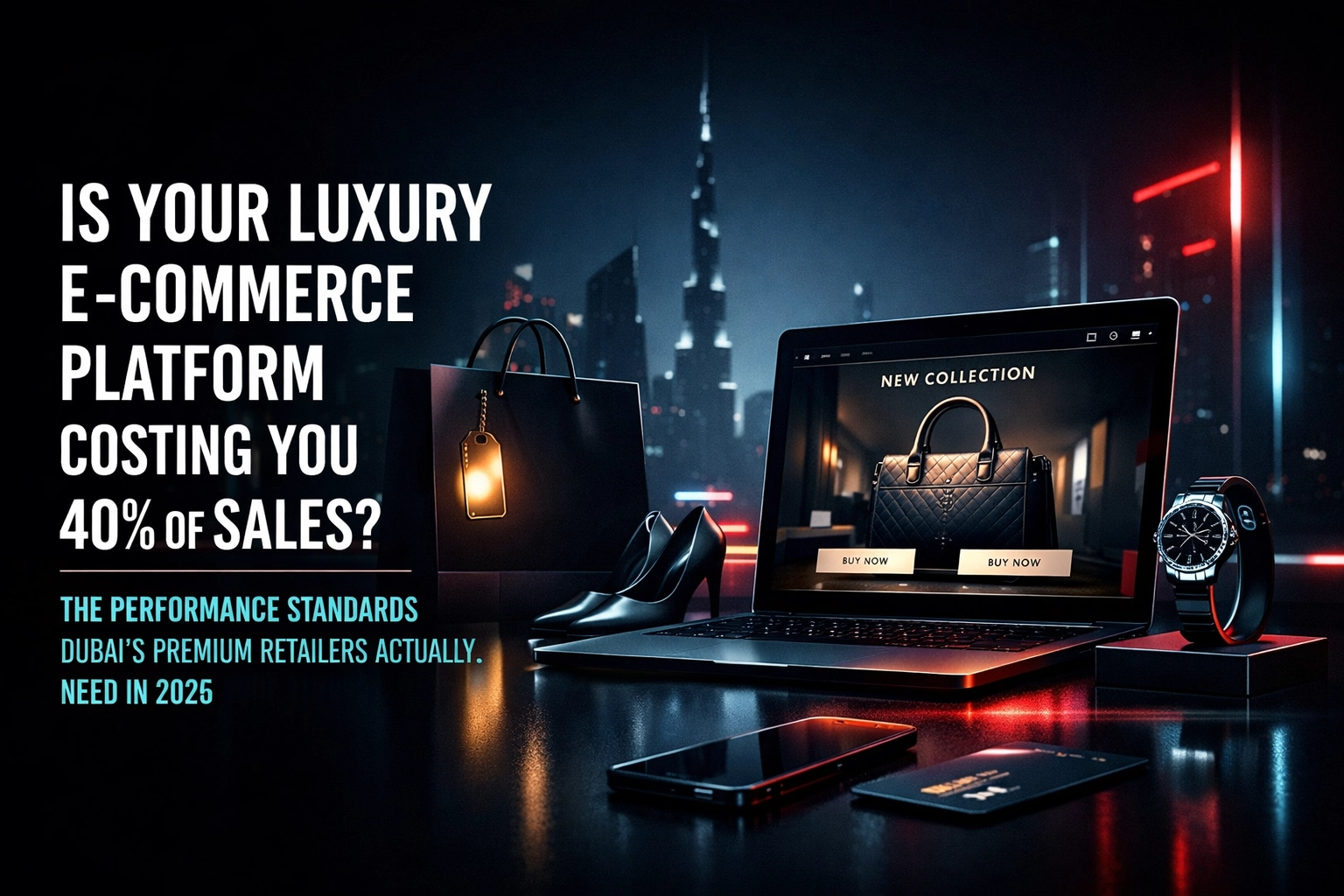
Your luxury customer navigates to your boutique's website. The hero image takes four seconds to load. The product carousel stutters. The checkout flow requires seven clicks across three pages. They abandon their AED 12,000 cart and visit a competitor instead.
This scenario plays out thousands of times daily across Dubai's premium retail sector. While you invest in exquisite inventory, prime locations, and exceptional in-store experiences, your digital storefront: the platform generating 60% of modern luxury purchases: operates on infrastructure designed for mass-market efficiency, not premium performance.
The financial impact? Industry data reveals that luxury e-commerce platforms built on template solutions lose an average of 40% of potential sales to performance bottlenecks, technical limitations, and experiences that fail to match the sophistication your clientele expects. In a market projected to reach $13.8 billion by 2029, these aren't minor inefficiencies. They're strategic vulnerabilities threatening your competitive position.
The Hidden Cost Structure of Template Platforms
Begin by examining what "affordable" actually means in luxury e-commerce. That AED 15,000 template platform might seem economical compared to custom website development, but examine the true cost equation over 24 months.
Template platforms impose recurring transaction fees ranging from 1.5% to 3% per sale. For a boutique generating AED 5 million annually, that's AED 75,000 to AED 150,000 in perpetual platform taxes: money extracted directly from margin with zero corresponding value increase. Add monthly subscription fees, premium plugin costs, and the inevitable custom development required to work around template limitations, and your "economical" solution quickly exceeds AED 200,000 over two years.
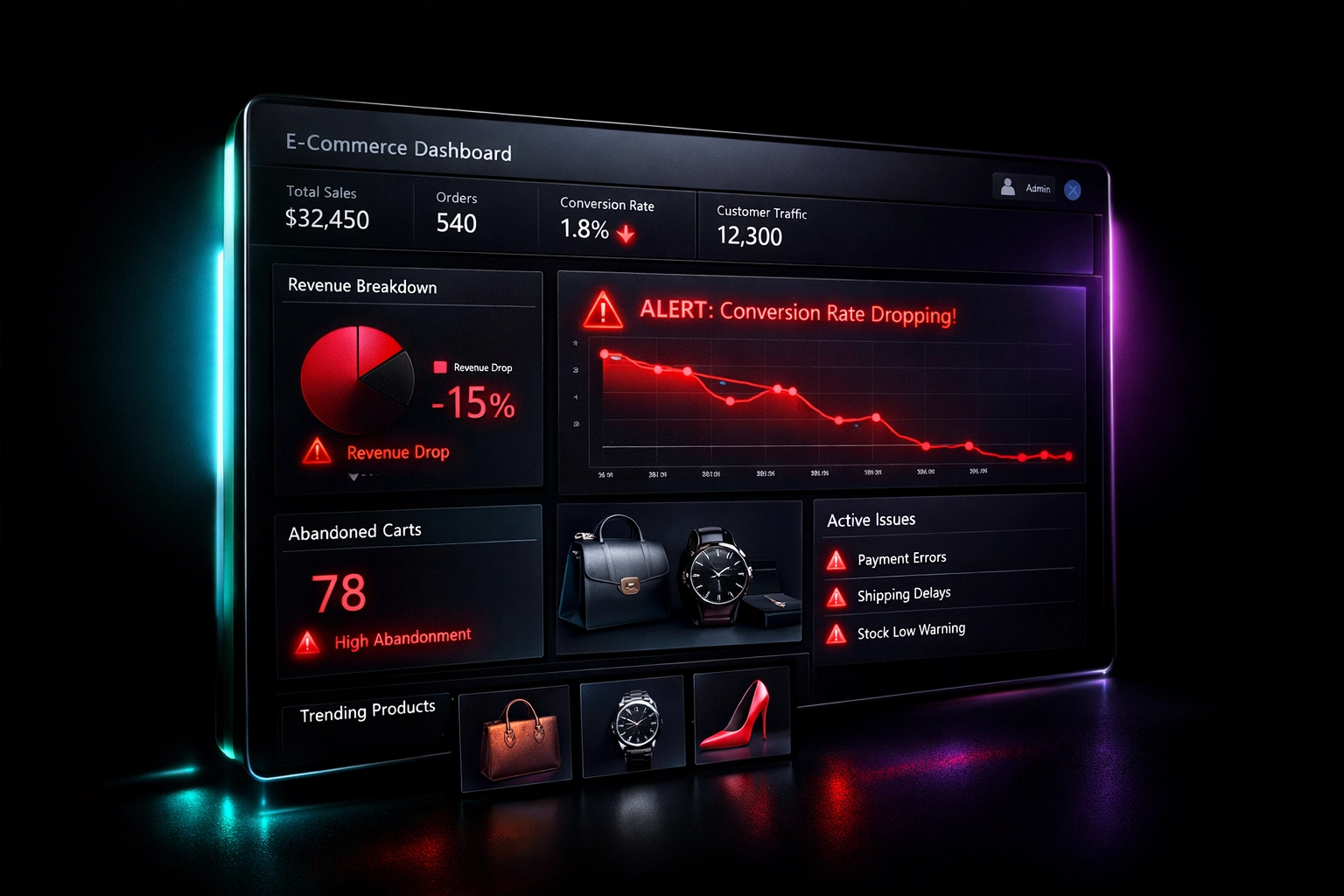
Custom solutions eliminate these recurring extractions. You own your infrastructure. You pay for development once, then invest only in hosting, security, and strategic enhancements that directly increase conversion value. For businesses processing significant transaction volumes, the cost equation inverts within 18 months, with bespoke platforms delivering superior economics alongside superior performance.
More significantly, template platforms impose opportunity costs that never appear on invoices. When you cannot implement the personalization engine that would increase average order value by 23%, or the dynamic pricing system that would optimize margin during peak seasons, or the seamless integration with your existing CRM that would reduce customer service overhead by 40%: these limitations translate to millions in unrealized revenue. You're not saving money. You're subsidizing your competitors who invested in platforms built for their specific strategic requirements.
The Performance Benchmarks Premium Customers Actually Demand
Your luxury customer operates with different expectations than mass-market shoppers. They're not looking for the lowest price: they're evaluating whether your digital presence matches the caliber of experience they anticipate from a premium brand. Performance becomes a quality signal, just as store ambiance and packaging communicate brand positioning in physical retail.
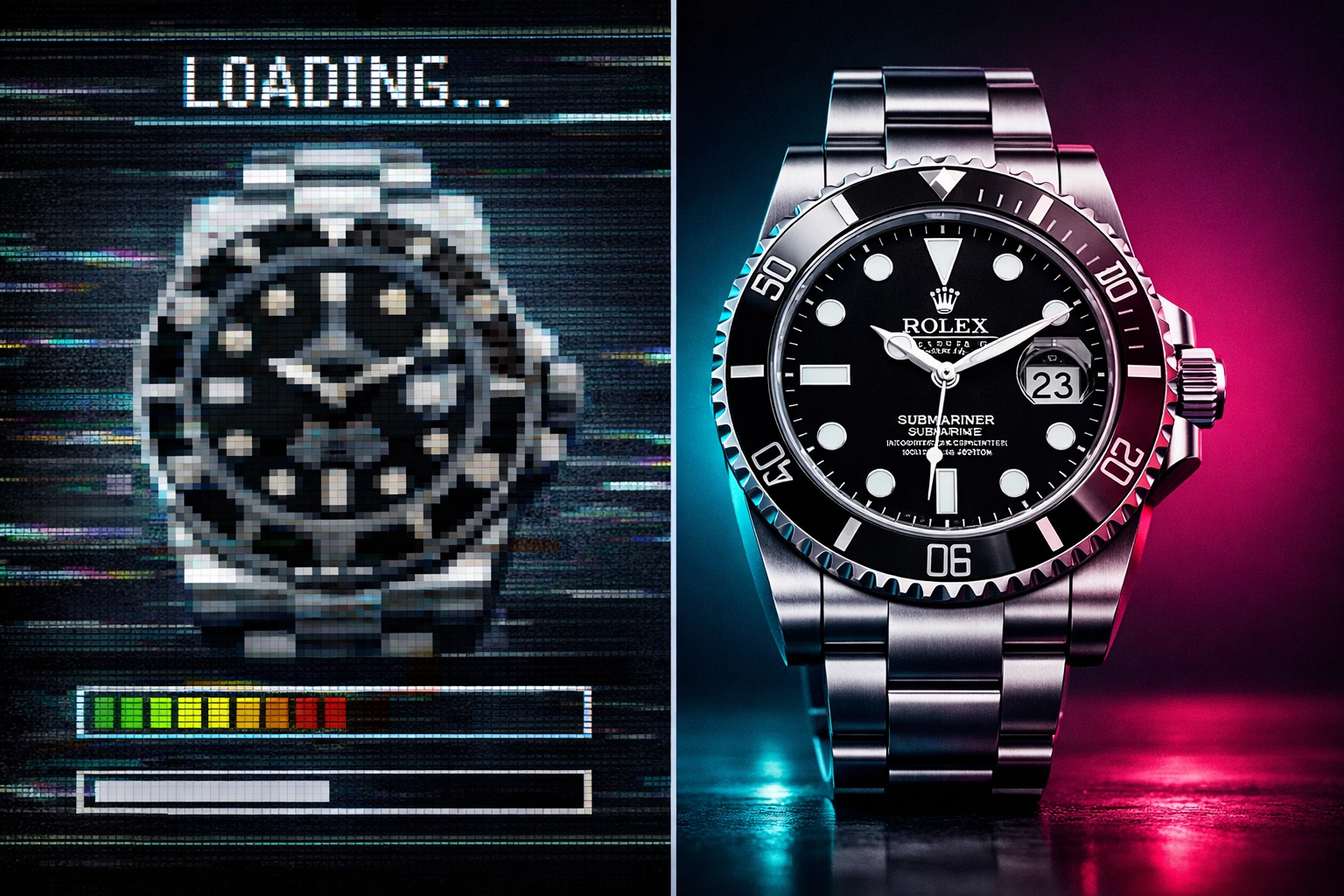
Start with load speed. Amazon's research established that every 100 milliseconds of delay reduces conversion by 1%. For luxury retail, the threshold proves even more sensitive. Premium customers accessing your site from Dubai Marina on premium devices expect instantaneous response. When your homepage requires 3.2 seconds to reach interactive state: the average for template platforms running on shared hosting: you've already communicated that your digital experience doesn't match your brand positioning.
Bespoke ecommerce website development dubai solutions achieve sub-second load times through performance-first architecture. By implementing advanced caching strategies, optimized image delivery, and code-level efficiency that template platforms cannot match due to their generalized structure, custom platforms deliver the instantaneous responsiveness luxury customers expect. This isn't a minor technical detail: it's the digital equivalent of greeting customers at your boutique entrance versus making them wait in a corridor.
Consider the mobile experience specifically. In the UAE, 73% of luxury purchases begin on mobile devices, even if they conclude on desktop. Your mobile experience serves as the primary brand interaction point, yet template platforms deliver mobile experiences as afterthoughts: desktop layouts awkwardly compressed to smaller screens, with navigation patterns designed for mouse cursors forced onto touchscreens. The result feels precisely like what it is: a compromise.
Custom ui ux design services create mobile-first experiences where every interaction feels intentional. Touch targets sized for thumb navigation. Swipe gestures that feel natural. Product imagery optimized for mobile bandwidth without sacrificing the visual fidelity luxury goods demand. When your mobile experience matches the sophistication of your products, mobile traffic converts at desktop rates: or higher.
The Integration Imperative: Why Disconnected Systems Kill Conversion
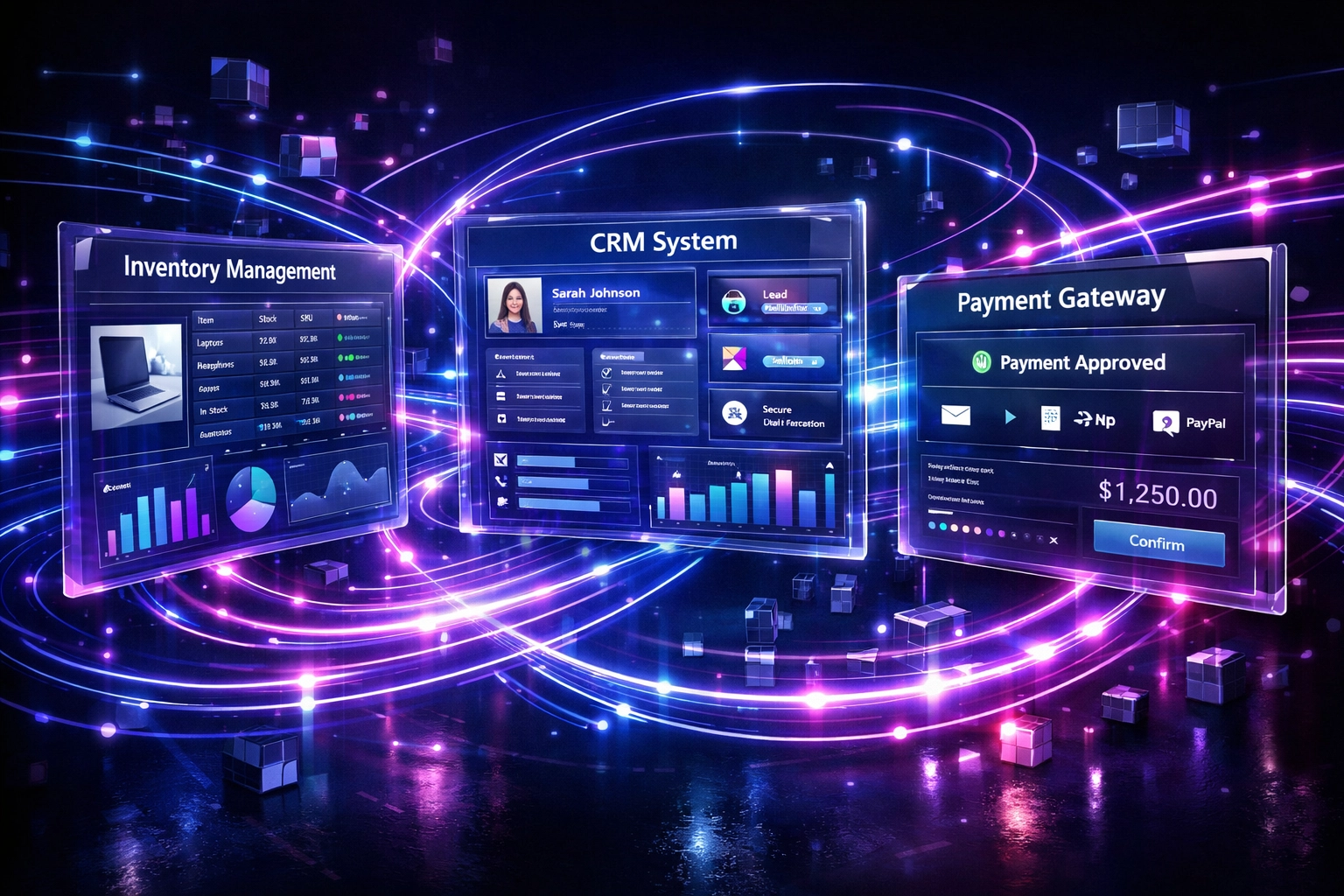
Your e-commerce platform doesn't exist in isolation. It connects to inventory management, CRM systems, marketing automation, payment gateways, shipping providers, and analytics platforms. Each connection point represents either seamless data flow or a manual process prone to error, delay, and customer frustration.
Template platforms offer "integrations" through third-party plugins: middleware that connects your platform to other systems through APIs designed for generic use cases. This creates fragile connection chains where data passes through multiple intermediary systems, each adding latency, potential failure points, and recurring subscription costs. When your inventory system updates, that change might take 15 minutes to reflect on your website. When a customer completes purchase, their information passes through four systems before reaching your CRM, with data formatting issues requiring manual correction.
Bespoke platforms implement direct integrations tailored to your specific technology ecosystem. Your inventory management system and e-commerce platform share a unified database, with updates reflecting instantly. Customer data flows directly to your CRM without middleware translation. Your preferred payment gateway integrates at the code level, creating checkout experiences that feel seamless rather than redirecting customers to external payment pages that break trust and increase abandonment.
These technical integration capabilities translate directly to customer experience quality. When a customer adds your last unit of a premium product to their cart, they need certainty that it's reserved for them: not the anxiety of discovering during checkout that inventory showed available but wasn't. When they complete purchase, they expect immediate confirmation and accurate delivery information: not a 24-hour delay while your systems reconcile. Custom development ensures these expectations meet reality.
The Personalization Engine Driving Modern Luxury Sales
Mass-market retail succeeds through volume optimization: showing bestsellers to everyone and accepting modest conversion rates. Luxury retail succeeds through relationship depth: understanding individual customer preferences and curating experiences accordingly. Your platform's personalization capabilities determine whether you're operating a digital shelf or a digital boutique.
Template platforms offer basic personalization: recently viewed items, products frequently bought together, category-based recommendations. These rudimentary features replicate what every competitor offers, providing no differentiation. They operate on aggregate data rather than individual understanding, showing your customer what's popular rather than what's relevant to their specific preferences, purchase history, and browsing behavior.
Custom platforms implement intelligent personalization engines that transform anonymous browsers into recognized individuals. When a customer who previously purchased eveningwear returns, they see coordinating accessories prominently featured. When someone browsing your site demonstrates preference for specific designers, collections, or aesthetic directions, subsequent visits prioritize relevant inventory. When purchase patterns suggest an upcoming occasion: anniversary, birthday, seasonal wardrobe refresh: the platform surfaces appropriate recommendations proactively.
This level of personalization requires sophisticated data architecture that template solutions cannot deliver. You need unified customer profiles consolidating online behavior, purchase history, customer service interactions, and even in-store purchase data for omnichannel retailers. You need machine learning models trained on your specific inventory and customer base rather than generic recommendation algorithms. You need the flexibility to implement personalization strategies aligned with your brand positioning rather than accepting whatever your template provider offers.
The conversion impact proves substantial. Luxury retailers implementing advanced personalization report average order value increases of 23% to 35%, with repeat purchase rates improving by similar margins. When customers feel understood rather than marketed to, they respond with loyalty and increased lifetime value.
The Security and Trust Infrastructure Premium Brands Require
Your luxury customers provide you with their payment information, shipping addresses, and personal data. They expect security infrastructure that matches their trust. Yet many premium retailers operate on shared hosting environments where their data resides alongside hundreds of other websites, protected by generic security measures designed for the average threat level rather than the elevated risk profile luxury brands face.
Begin with payment security. Template platforms typically route payments through third-party processors, with transactions occurring on external pages. This reduces your PCI compliance burden but creates customer experience friction: that moment when they're redirected away from your site breeds abandonment. Custom platforms implement payment processing at the application level, maintaining brand continuity throughout checkout while adhering to the highest security standards.
Consider the broader security infrastructure. Custom development allows implementation of enterprise-grade security measures specifically calibrated to luxury retail threat profiles. This includes advanced DDoS protection, intrusion detection systems, encrypted data storage, and regular security audits conducted at the code level. When a security vulnerability emerges, your development team patches your specific platform immediately rather than waiting for a template provider to issue a universal update that may take weeks.
The trust implications extend beyond technical security to include data governance. With bespoke platforms, you maintain complete control over customer data, ensuring compliance with UAE data protection requirements while implementing privacy standards that match your brand commitments. Template platforms often include terms of service granting the platform provider rights to customer data for their own purposes: a arrangement incompatible with the discretion luxury customers expect.
The Strategic Flexibility That Separates Market Leaders From Followers
Market conditions evolve. Customer preferences shift. New technologies emerge. Competitors innovate. Your e-commerce platform needs the adaptability to respond to strategic opportunities as they arise, not in six months when your template provider adds a feature to their roadmap.
Template platforms lock you into their development priorities. When you identify a strategic opportunity: implementing augmented reality product visualization, adding live personal shopping video consultations, creating a members-only pre-release program with complex eligibility rules: you're dependent on whether your platform supports these features. Usually, they don't. You can request custom development, which arrives slowly at premium prices, or you accept strategic constraints imposed by your technology choices.
Custom website development provides the flexibility to implement strategic initiatives immediately. Your development team builds the features your strategy requires, on your timeline, integrated seamlessly with your existing platform. When you decide to launch a virtual showroom for high-value items, you build it. When you want to implement a sophisticated loyalty program with tier-based benefits and exclusive access, you create it. Your platform enables strategy rather than constraining it.
This flexibility compounds over time. After two years, competitors operating on template platforms all offer similar feature sets: whatever their shared provider supports. Meanwhile, your bespoke platform has evolved specifically to support your unique strategic positioning, creating differentiation that cannot be quickly replicated. Your technology infrastructure becomes a sustainable competitive advantage rather than a commodity cost center.

Making the Investment Decision: Cost Versus Value in 2026
The choice between template and custom platforms ultimately represents a strategic decision about how you position technology in your business model. If your e-commerce channel serves primarily as an additional distribution mechanism: convenient but not central to your brand strategy: template solutions may suffice. But if digital commerce represents a primary customer interaction point and growth driver, technology investment becomes non-negotiable.
Evaluate the decision through return on investment rather than upfront cost. Custom ecommerce website development in Dubai typically requires investment between AED 250,000 and AED 500,000 for sophisticated luxury retail platforms, compared to AED 15,000 to AED 50,000 for template implementations. The gap appears substantial until you calculate returns.
A custom platform eliminating 3% transaction fees on AED 5 million in annual sales saves AED 150,000 yearly. Improved conversion rates adding 2 percentage points to a baseline 2.5% conversion rate generate an additional AED 1.6 million in annual revenue at your average order value. Enhanced personalization increasing average order value by 25% compounds that revenue increase further. Within the first year, the platform pays for itself. Every subsequent year represents pure value creation.
Consider also the opportunity cost of delayed optimization. Every month operating on a platform that cannot support strategic initiatives represents lost competitive ground. In Dubai's rapidly evolving luxury market, where consumer expectations advance continuously and new competitors emerge regularly, the ability to innovate digitally provides crucial strategic advantage.
The Performance Standards You Should Demand
As you evaluate your current platform or consider new development, establish clear performance benchmarks. Your luxury e-commerce platform should deliver:
Load Performance: Complete page load under 1.5 seconds on 4G connections, with perceived load speed (time to interactive) under 1 second through progressive rendering techniques.
Mobile Experience: Purpose-built mobile interface achieving conversion rates within 10% of desktop performance, with touch-optimized navigation and image quality matching desktop standards.
Personalization Depth: Individual customer recognition across sessions, with product recommendations based on browsing behavior, purchase history, and predictive modeling rather than simple popularity rankings.
Integration Completeness: Real-time synchronization with inventory, CRM, and operational systems, eliminating manual data reconciliation and ensuring consistent customer experience across channels.
Security Infrastructure: Enterprise-grade protection including SSL encryption, PCI Level 1 compliance, regular penetration testing, and data governance meeting international privacy standards.
Customization Capability: Ability to implement strategic features within weeks rather than months, with development occurring on your timeline rather than vendor roadmap.
These benchmarks aren't aspirational goals: they represent baseline standards for competitive luxury e-commerce in 2026. Platforms failing to meet these standards impose concrete costs through lost sales, operational inefficiency, and strategic constraints.

The Path Forward: From Constraint to Capability
If your current platform falls short of these standards, you face a strategic decision. Continuing with inadequate infrastructure means accepting competitive disadvantage as the gap between your capabilities and market standards widens. The longer you delay transformation, the more expensive catch-up becomes and the more difficult winning back customers who've shifted to competitors with superior digital experiences.
The alternative involves approaching platform development as a strategic investment rather than a technology expense. Partner with specialists in custom website development who understand luxury retail's specific requirements. Work with ui ux design services experienced in translating premium brand positioning into digital experiences that drive conversion. Implement platforms built specifically for your strategic requirements rather than adapted from generic templates.
This transition requires investment, but consider the cost of inaction. Every day your platform operates below standard, you lose sales to competitors who invested in superior infrastructure. Every customer who abandons their cart due to performance issues or friction in your checkout process represents both immediate lost revenue and potential long-term relationship value. Every strategic initiative you cannot implement because your platform lacks necessary capabilities represents market position ceded to more agile competitors.
The luxury retail landscape increasingly divides between brands treating digital commerce as a strategic priority: investing accordingly in bespoke platforms that enable differentiation: and brands treating it as a necessary cost center, deploying template solutions that deliver generic experiences. Which category defines your competitive position determines your relevance in a market where 60% of luxury purchases now involve digital interaction.
Your platform either enables your strategy or constrains it. It either differentiates your brand or commodifies it. It either drives profitable growth or leaks revenue through a thousand small inefficiencies. The choice remains yours, but the window for transformation narrows as market standards advance and customer expectations evolve.
The question isn't whether you can afford to invest in performance standards that match your brand positioning. The question is whether you can afford not to.
Leave a Reply